11 The Jock
Early in life, football and basketball were what I lived for. As young kids, we played tackle without any padding on the playground at school. We would come in quite beat up after recess, and eager to do it again.
When I was in 6th grade in 1955, Dad put up a basketball goal out by the pump house where I spent hours learning to shoot and dribble. The Shell boys played with me when they could, and Dad came out at times and taught me how to rebound and put the ball “back up”. Dad told me that if I wanted to excel in basketball, I needed to learn to play equally well with both hands: that is, shooting as well as dribbling. I practiced using my left hand to dribble and make layups, and I improved my long shot. I began learning about defense in Jr. High School.
In 7th grade, the new physical education instructor started teaching us how to play football. My neighbor in the 8th grade, Kenny Shell, told me that the first thing the coach did with the 8th graders was to line them up and run one quarter mile lap around the school track. The first four guys to finish became the backfield.
That was on Friday, and I started running a lot that weekend in anticipation. When it was our turn on Monday, I knew what I had to do. The coach did not tell us what he had in mind but told us to arrange ourselves in a row according to how fast we ranked ourselves, with the fastest kid in front. I recall a bit of jostling and arguing over who went in which order. I did not make any claims and ended up in the middle of the line along with others who did not perceive me to be particularly fast. Coach told us he wanted to see who could run the fastest quarter of a mile.
He shot off a starting pistol for effect, and we all took off. As I passed Harlan Stark, the guy who had crowded in front of me earlier, he yelled out, “Run slowly in the beginning so I would not be too tired to finish.” Well, I did not listen and charged out, took the lead right away, and although I was tired, I continued to increase the distance between me and the others. At the finish line, I was at least 40 yards ahead of everyone else! I was exhausted and happy that I had, for the first time in my life, been able to prove myself physically among my peers. I gained self-confidence, enabling me to excel in sports. On top of that, I was assigned to play in the backfield!
We learned some football, and halfway through 7th grade, the Coach gave us a chance to play the 8th graders. The school had no football equipment, so we played without pads. It was a memorable game. I remember making most of the tackles for the 7th graders, resulting in a rather close game! I made a name for myself that felt good!
By the time I was in ninth grade, I was ready to play high school football. I had never experienced such grueling practice. During practice, I liked the tackling, but I hated the part where we had to let ourselves be tackled and slammed onto our backs! That was quite a painful experience, which soon led me to the discovery that I had a deformity in my lower spine. As a freshman, I finished the season without playing in many games, but I still played defensive end when I got the chance.
At the end of the season, my doctor informed me that I had spondylolysis and that I should not play sports! This was devastating because up to then, athletics was my life. What was even worse, I had to forgo playing basketball, my favorite sport. The coach let me participate as the team manager for the “B squad.” I still shot baskets with the team; in spite of my condition, I was pretty good.
In the spring of that year, I went to the orthopedist again, and when he learned that I had continued to be physically active, he did not chide me. He told my parents that I could play whatever sport I wanted, and if it hurt too much, I could just stop. He said that I could wait until I finished high school before getting a spinal fusion. I was delighted that I could play sports again and had already learned how to avoid getting hurt.
My sophomore year was great as I was able to shine in sports, with the opportunity to play first-string end on the varsity football team and lead the basketball B squad in scoring for the year. At the end of the season, the coach asked me to travel with the A team to play in the conference tournament. I sat on the bench most of the game but did get to play for a few minutes.
My junior year was a fresh start, and I quickly made the first-string basketball team and played every game of the season. Bill Kyger, a senior, and I were selected for the All-Conference team that year. I was in heaven with basketball! My senior year went well, and I was selected for All-Conference again. We had good teams during those years, but we never won the conference title.
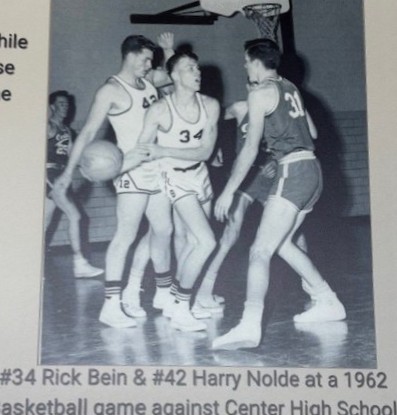
Photo from Berthoud Bulletin archives in the Berthoud Historical Society files.
I played a lot of football during my junior and senior years. A new coach took over our football team at the beginning of my junior year, and, since I was a big guy, he decided I should play tackle. That was not my first choice, but I did not complain. Then, in mid-season, our main running back, Kenny Shell, was injured in the middle of the game, so I volunteered to replace him. I proved myself that day and stayed in the backfield from then on.
We did not have a very good team. We had so few players that I had to play defense as well as offense. We had a lot of injuries my senior year, and I remember we had only 12 players in the last game of the season. Maybe we should have been playing 8-man football!
I do remember one particular play that I revel in from time to time. I was playing tailback in a single-wing formation and, when the ball was hiked, I pretended to hand it off to Ray Hall. He also pretended that he had the ball buried against his stomach, hunching over, running toward the right end, diving into a gang of tacklers. The referee blew his whistle and began pulling the players off the pile, and when he got to Ray, there was no football! Meanwhile, I was casually trotting wide to the left side, hiding the ball behind my back with one hand, looking back at where Ray was running. No one thought I had the ball and had already gained ten yards when the whistle blew. A couple of guys in the other team’s secondary decided I looked a little suspicious and came after me. Then I tucked the ball and began running full speed, but they were still able to stop me after a thirty-yard gain. After the game, the referee congratulated our coach on his deception.
We had a small-town school conference where we played teams from Erie, Johnstown, Lyons, Timnath, Evans, Mead, and Millikan. When we played football at Estes Park up in the mountains, they did not have enough flat space for a football field. Their field was only eighty yards long, and adjustments were made during games. When the ball changed hands, the line of scrimmage was backed up 20 yards to compensate. They had only one goal post for kicking extra points and field goals. Both teams had to kick at the same goal post, which backed up to the main street. Traffic had to be stopped when those kicks occurred. Visitors to Rocky Mountain National Park had to wait a few minutes.
I was offered a college scholarship to play football at Colorado School of Mines. They withdrew the offer when they learned that I was to have a back operation. A few days after graduation from high school, my parents took me to the Children’s Hospital in Denver to have a spinal fusion of my lower lumbar vertebrae, which ended my sports career.
I spent the summer of 1962 recovering from the operation: two weeks in the Children’s Hospital and then six weeks at home in a full body cast.
I went off to Oberlin College in the fall, wearing a back brace as my back was healing. I went out for the basketball team, played ten minutes in one game, and completed the only shot I ever took in college basketball. When my surgeon adamantly wrote to the coach that under no conditions could I participate in sports for an entire year, my college sports ended. I still played intramural basketball, where I did not need to pass a physical exam.
Not being allowed to play college sports was a hard blow for me, but in the long run, it offered me the opportunity to find myself in different ways. Academically, I was not prepared for university, and I had a lot of catching up to do if I was to earn a bachelor’s degree.
My first year at Oberlin was an academic disaster; I had no idea how to study, let alone read a boring textbook. Naively, I signed up for first-year calculus and had no idea how to read the math book, ask any questions, or get help! I failed that course, earned Ds in everything except English. That C, I think, was a gift. The second semester, I fared no better. I realized that I was going nowhere at Oberlin and needed to find a place that was less competitive and start over.
After a long, depressing summer (1963), I enrolled at Mesa Junior College in Grand Junction. There, I found myself among the stronger students and was able to recover from the degradation of the previous year. I started at a lower level in math and passed calculus in the third quarter. I completed the first year of Spanish, enjoyed speech, theater arts, and political science. After this successful year of basic courses, I still did not have a major course of study. I was lost but planned to continue at Mesa College. A dear family friend, Professor Howard (Stoney) Stonaker, suggested that I apply to the Peace Corps. He said that they were looking for people with agricultural experience, which would outweigh the need for a college degree.
I obtained an application, quickly filled it out, and mailed it. That August in 1964, I was working as a trail crew in Rocky Mountain National Park when I received a phone call from home about a Peace Corps offer to work in Brazil.
A whole new life began!
https://pressbooks.com/